Oral Sleep Apnea Appliance
A small, custom-made device worn only at night — no mask, no hose, no machine. For the right patient, it is the treatment that finally sticks.
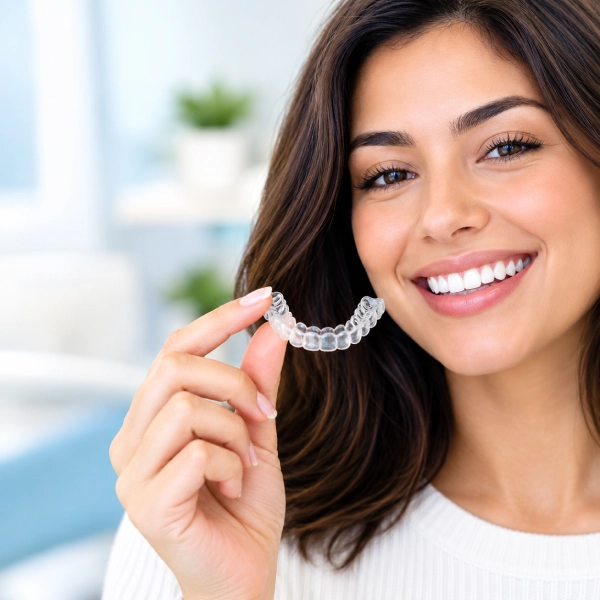
A Mouthguard That Keeps Your Airway Open
An oral sleep apnea appliance — clinically a mandibular advancement device (MAD) — is a custom-fitted dental appliance worn during sleep. It gently holds your lower jaw slightly forward, which pulls the tongue muscles forward with it. Because the tongue is attached to the jaw, moving the jaw forward moves the base of the tongue away from the back of the throat, keeping the airway wider while you sleep.
The physics is simple; the fitting is not. A poorly fitted over-the-counter boil-and-bite guard can move teeth, strain the jaw joint, and still fail to open the airway. A properly fitted appliance is designed from a digital scan of your teeth, adjusted in precise increments, and monitored over years — which is the difference between a device you wear for a decade and one that sits in a drawer.
- First-line treatment for mild to moderate obstructive sleep apnea
- Recommended for patients who cannot tolerate CPAP
- Silent, pocket-sized, and travel-friendly
Why Moving the Jaw Forward Opens the Airway
The tongue is not floating free — its base is anchored to the inner surface of the lower jaw. That anatomical fact is the entire principle behind the appliance.
The Appliance Grips Both Arches
Two custom trays — one over your upper teeth, one over your lower — connect with precision hardware that controls exactly how far forward the jaw is held.
The Jaw Advances a Few Millimeters
Holding the lower jaw forward carries the tongue base forward with it, physically enlarging the space behind the tongue where most airway collapse begins.
The Airway Stays Open All Night
With the tongue stabilized, throat tissue no longer gets sucked inward on each breath — reducing apneas, eliminating most snoring vibration, and keeping oxygen steady.
Who Benefits Most From an Oral Appliance
A sleep study and a physician's input decide the treatment category — here is where the appliance usually fits.
Mild to Moderate OSA
Guidelines from the American Academy of Sleep Medicine position oral appliances as first-line therapy for mild to moderate obstructive sleep apnea, with success rates rivaling CPAP because patients actually wear them.
CPAP Intolerance
If you have severe apnea but cannot tolerate a mask, an appliance is still far better than nothing. Many severe patients combine a low-pressure CPAP with an appliance — lower pressure, smaller mask, better comfort.
Chronic Snorers
Not every snorer has apnea, but appliance therapy reliably quiets even simple snoring — often the kindest gift a bed partner ever receives.
Frequent Travelers & Campers
No outlets, no luggage-space sacrifices, no power failures. The device fits in a small case and works anywhere you sleep.
Positional & Anatomy-Driven Apnea
Patients with a recessed jaw or tongue-driven collapse often respond exceptionally well, because the appliance directly addresses their anatomy.
Who It's Not For
Young children, patients with too few healthy teeth to anchor the device, significant active TMJ disorders, or central sleep apnea all need a different pathway — we will tell you honestly if that includes you.
How We Fit Your Appliance
The whole process usually takes two to four weeks from first visit to wearing your finished device.
1. Consultation & Records
We review your sleep study results and physician notes, examine your teeth, bite, jaw joint, and airway, and take a digital scan of your mouth — no messy impressions.
2. Design & Fabrication
Your appliance is designed on the scan and fabricated by a certified dental laboratory, usually within two weeks. We verify your sleep physician is aware of the plan.
3. Delivery & Calibration
At delivery we fine-tune the fit and set a starting advancement position. Over follow-up visits we advance the jaw in small increments — enough to open the airway, never more than comfort allows.
4. Follow-Up & Verification
After you have adjusted, we may recommend a home sleep verification test to confirm the appliance is actually controlling your apnea — then see you every six months to check fit, bite, and symptoms.
Adjusting to Life With the Appliance
The first weeks are an adjustment period. Here is what patients typically experience and how we handle it.
The First 1–3 Weeks
Mild jaw stiffness or tooth tenderness on waking is normal and fades as you adapt. Start with evening wear while relaxing, then move to full nights.
Protecting Your Bite
Any device that moves the jaw can nudge the bite over time. That is why we check your bite at every follow-up — small corrections early prevent problems later.
Daily Care
Rinse it after removal, brush it gently with a soft brush, and store it dry in its case. Bring it to every hygiene visit so we can clean and inspect it professionally.
Oral Appliance Questions, Answered
What patients ask us before committing to the device.
How is a custom appliance different from a store-bought snoring guard?
Will it move my teeth or change my bite?
How long does the appliance last?
Does insurance cover an oral sleep apnea appliance?
What if I already use CPAP and it mostly works?
Ready to Retire the Mask?
If CPAP has been sitting on your shelf more often than on your face, it is time for a conversation. Bring your sleep study or let us help you get one — we will show you exactly what a custom appliance could do for your nights.